
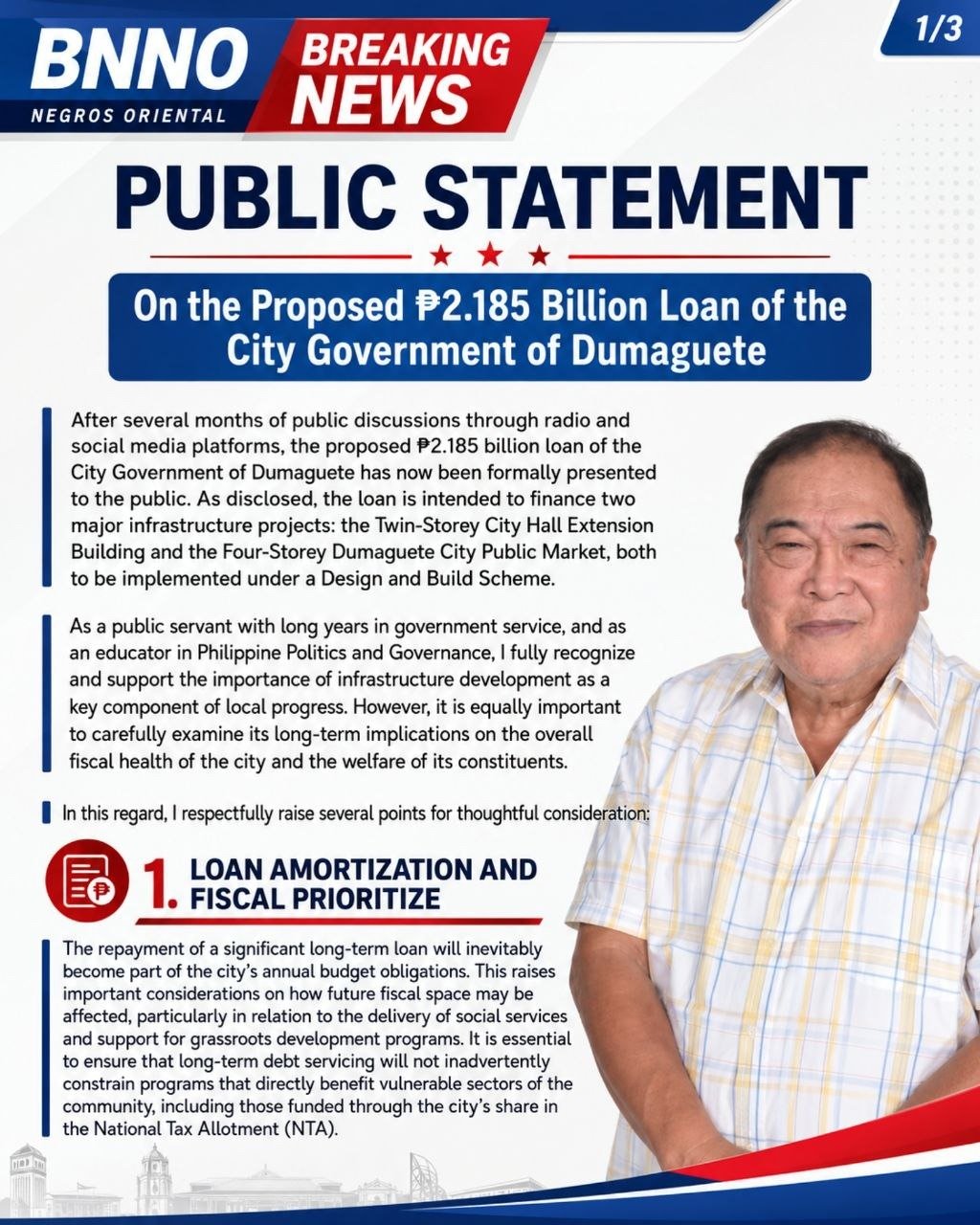
Before the Dumaguete City Council votes on a proposed ₱2.185 billion loan, at least one voice from civil society is urging elected officials to slow down and take a harder look at the numbers. Attorney Petit Baldado, a former Dumaguete city councilor, released a formal written statement on Friday, May 22, 2026, laying out five specific fiscal concerns he believes must be addressed before any final decision is reached.
The loan in question is intended to fund two distinct city infrastructure projects: a Twin-Storey City Hall Extension Building and a Four-Storey Dumaguete City Public Market. Both are to be executed under a Design and Build Scheme — a procurement arrangement in which a single contractor is responsible for both designing and constructing the facility. Baldado acknowledged in his statement that the projects carry legitimate development value for Dumaguete City, but argued that the scale of the financial commitment warrants careful public scrutiny.
Months of Public Discussion Now Formalized
According to Baldado’s statement, the loan proposal had already been circulating in public discourse for some months prior to its formal presentation, with discussions taking place across radio broadcasts and social media platforms. His written statement, he indicated, was intended to consolidate those concerns into a structured document directed at the city’s legislative body — the Sangguniang Panlungsod — for its deliberation.
Baldado framed his intervention not as opposition to infrastructure development, but as a call for evidence-based governance. He said he supports the idea of improving city facilities in principle, but questioned whether taking on a loan of this size at this particular point in time represents the most fiscally sound path forward for the local government.
Loan Repayments Could Eat Into Essential City Programs
Among the concerns Baldado outlined, he placed particular emphasis on the long-term impact of debt service obligations on the city’s annual budget. A loan of ₱2.185 billion, once approved, would become a fixed repayment commitment in every succeeding city budget until the obligation is fully settled — a reality he warned could reduce the fiscal space available for social programs and community-level services.
“It is essential to ensure that long-term debt servicing will not inadvertently constrain programs that directly benefit vulnerable sectors of the community, including those funded through the city’s share in the National Tax Allotment (NTA),” Baldado said in his formal statement.
The NTA — which replaced the Internal Revenue Allotment under the landmark Mandanas-Garcia Supreme Court ruling — represents one of the most significant revenue streams for local government units across the Philippines, funding a wide array of public services at the local level. Any reduction in available NTA funds, or any large competing obligation drawing from the same budget pool, could limit a city’s capacity to deliver basic services to its constituents.
National Economic Pressures Add Another Layer of Risk
Baldado also pointed to the broader national economic environment as a complicating factor. He cited persistent inflation as an ongoing burden for both households and government operations alike, and noted that officials from the Department of Finance and national economic planning agencies have publicly acknowledged the country’s growing debt load and the fiscal pressures it creates.
While Baldado recognized that local governments like Dumaguete City retain a degree of fiscal autonomy under the Local Government Code, he cautioned in his statement that national-level financial constraints can still have indirect effects on intergovernmental fund transfers and on the priorities that shape local government planning over time. He argued that these conditions make it all the more important to assess the timing of a major loan commitment with care.
COA Audit Findings on LGU Infrastructure Used as Reference
To reinforce his case for caution, Baldado drew on the documented audit experiences of other local government units around the country. He cited observations from the Commission on Audit (COA) involving LGU-funded infrastructure projects that have faced problems such as implementation delays, cost overruns, and procurement inefficiencies.
“These findings underscore the importance of ensuring strong feasibility studies, transparent procurement processes, and robust project monitoring systems to safeguard public funds and ensure project effectiveness,” Baldado said in the statement. He did not reference specific COA report numbers or case details, but pointed to a broader pattern of audit observations that he argued should serve as instructive precedents for Dumaguete’s deliberation.
A Call for Comprehensive Feasibility Study and Alternative Funding Review
Rather than calling for the outright rejection of the proposed loan or its associated projects, Baldado’s statement centered on the need for a thorough, transparent, and expert-driven feasibility study to be completed before any commitment is made. He argued that such a study is necessary to verify that the financial obligation will not undermine the city’s capacity to fund public services or compromise its long-term fiscal stability.
Beyond the feasibility study, Baldado also suggested that city planners revisit the scheduling and prioritization of the two projects and explore whether alternative funding mechanisms — such as grants, phased budgetary allocations, or other financing instruments — might achieve the same development goals without locking the city into a single massive loan obligation.
“A careful review of priorities, timing, and possible alternative funding mechanisms may help ensure that development initiatives remain both necessary and financially responsible,” his statement read.
Message Addressed Directly to City Councilors
Baldado directed the closing portion of his statement to the elected members of the Dumaguete City Council, expressing trust in their ability to deliberate independently and with the public interest as their guiding principle.
“I remain confident in the wisdom and independence of our elected City Councilors, trusting that they will carefully deliberate on this matter and act in the best interest of the public, guided by their principles and mandate to uphold the welfare of the people,” he wrote in the document.
He concluded with a passage written in Cebuano, identifying himself and reaffirming his personal commitment to the city and its residents. The statement translates broadly as a pledge that, regardless of what may come, he will remain devoted to Dumaguete City and its people.
No Official Response Yet From City Government
As of the date of publication — Friday, May 22, 2026 — neither the Dumaguete City Council nor the Office of the City Mayor had issued any formal response to the concerns raised in Baldado’s public statement, according to available reports.
The ₱2.185 billion loan proposal, along with the two infrastructure projects it is intended to finance, remains under the deliberative authority of the Sangguniang Panlungsod of Dumaguete City. The council’s eventual decision — whether to approve the loan, seek modifications to its terms, or explore alternative funding routes — will determine the fate of both projects.
Members of the public interested in following how the council proceeds on this matter are encouraged to monitor official announcements and communications from the Dumaguete City Government through its verified public channels.
Source: breakingnewsnegrosoriental.com